Open Pedagogy Pit Stop: A Case Study on How Google Gemini Can Help Build Educational Tools From Scratch
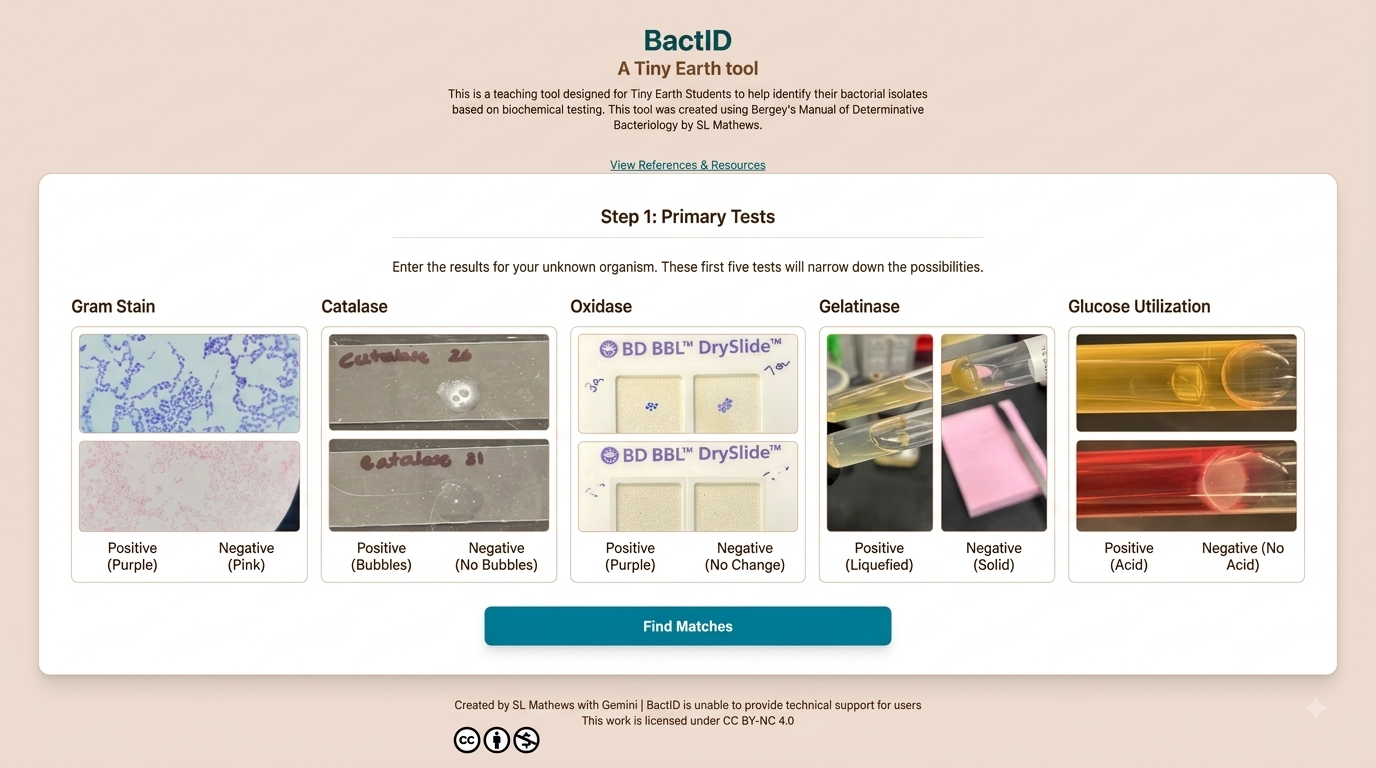
Dr. Stephanie Mathews partnered with the Libraries through the Open Pedagogy Pit Stop Program to use Gemini to help build a web-based platform to assist students in identifying biochemical test results.
Overview
In microbiology, biochemical testing is commonly used to obtain a putative identification of bacterial isolates; however, interpreting these results can be challenging, particularly when working with unknown environmental microbes. This challenge is compounded by the immense diversity of soil bacteria and the fact that many bacterial species remain undescribed.
Dr. Stephanie Mathews recognized this teaching challenge, and through her participation in the Open Pedagogy Pit Stop Program, was able to use artificial intelligence (AI) to develop a web-based platform, BactID.com, to assist students in identifying biochemical test results. The Pit Stop Program, a collaboration between the Libraries, DELTA, and the Office for Faculty Excellence (OFE), provided the drawing board for Dr. Mathews to develop her project amongst an interdisciplinary cohort of instructors and facilitators. This collaboration helped her refine her ideas and project development as program meetings combined lessons on topics such as open pedagogy and gamified learning with lab time for instructors to put what they’ve learned into practice. This work culminated in a comprehensive, open, and accessible webpage that helps students identify their bacterial isolates on biochemical testing in an easy-to-understand format.
How We Did It
To develop her project and address her teaching challenge, Dr. Mathews utilized artificial intelligence (Google Gemini) and established resources in determinative bacteriology to create BactID.com. Although Dr. Mathews entered the Pit Stop program completely new to coding, she was able to employ Gemini to help her build her website from scratch. The web-based platform allows students to enter biochemical test results and receive potential bacterial identifications based on characteristic profiles. Students then validate these predictions using 16S rDNA sequencing, providing an opportunity to compare traditional and molecular approaches to microbial identification.
Dr. Mathews began this process by creating a spreadsheet of about 20 organisms of soil bacteria and characterization results using a combination of Gemini, Bergey’s Manual, and other resources. She then asked Gemini to convert this spreadsheet into a JSON file and create a webpage. HTML was used to create the webpage with GitHub, with code refinement created by Gemini to ensure that the HTML webpage reflected both the full dataset and intended outcomes, images, and any stylistic and aesthetic choices.
The tool was implemented in a Tiny Earth Course-based Undergraduate Research Experience (CURE), where students used BactID.com while investigating antibiotic-producing soil bacteria.
As an Open Educational Resource (OER) published under a Creative Commons Attribution-NonCommercial (CC BY-NC) license, other educators are welcome to use BactID as-is or view and adapt the underlying code to build similar tools for their own courses. Visitors can refer to the site to access the GitHub repository containing the complete source code files, review a summary of the Gemini AI prompts used during the development process, or submit a form to request adding new bacteria to the BactID database.
What's Next?
Dr. Mathews plans to continue collecting feedback to improve BactID.com, and has recently been awarded an Alt-Textbook Project grant to continue her work with open education.
With support from the Libraries, Dr. Mathews will also present her project at the American Society for Microbiology Conference for Undergraduate Educators (ASMCUE) later this year, sharing the resource with a national community of microbiology educators.


