Esports + Tiny Café
The NC State Gaming and Esports Lab (GEL) opened in the Hunt Library in January 2024. We conducted two user research studies using the Tiny Café model to learn how patrons were utilizing the new space. We received a highly positive response from participants at both Tiny Cafés, with 94% of students who had visited the space before saying they intended to come back. Participants described the space as welcoming, friendly, and joyful—and the majority said they would bring a friend to the GEL even if that friend had no gaming experience.
Overview
The NC State Gaming and Esports Lab (GEL) in the Hunt Library opened in January 2024 to support NC State University’s Esports program. The space contains 35 gaming PCs and four gaming console stations. The lab is utilized by both casual and competitive gamers, and it hosts livestreamed esports competitions.
In April and October 2025, we conducted two user research studies using the Tiny Café model. In total, 40 students participated in semi-structured interviews about their attitudes towards, and use of, the new space. We received an overwhelmingly positive response, with 94% of the students who had visited the space before saying they planned to return in the future. A high percentage of participants (85%) also said they would feel comfortable bringing a friend to the GEL regardless of how much gaming experience the friend had.
Students used a total of 33 adjectives to describe the vibe of the space. Most responses were positive and ranged from gamer vibes, passionate, competitive, focused, intense, and professional to fun, mellow, cozy, welcoming, friendly, joyful, casual, and calm. There were very few negative responses, with a couple of participants saying the vibe was loud.
When asked what they liked about the space, and specifically about furniture and lighting, 63% of participants said the furniture was comfortable, and 53% said they liked the lighting. The most popular features participants brought up unprompted were the high-end equipment and the PCs.
Variation between daytime and nighttime study
One of the studies was conducted during the early afternoon, and the other was conducted later at night. While many responses from participants in each study were similar, there were also some interesting differences.
Participants in the nighttime study were slightly more likely to have visited the space before: 86% said they had visited before, compared to 79% of participants in the daytime study. Participants in the nighttime study were more likely to have been at the Hunt Library specifically to visit the GEL: 29% said they had come to the Hunt Library specifically to use this space, compared to 16% in the daytime study.
Participants in the nighttime study were also much more likely to have connected with someone new in the GEL and brought their own equipment to the space.
Recommendations
- Investigate new mice and keyboards, and add various peripheral options to the technology available to lend within the space.
- Investigate lighting alternatives, particularly natural light or lamps, both of which were specifically mentioned by participants.
- In training for the student employees who staff the staff, reinforce:
- Reminding players not to crowd in when watching their friend's game
- Reminding players that this is a shared space when games get noisy
- Conduct follow-up user research on several topics explored in this study:
- User interest in proposed additions to the space, such as tabletop gaming and collectible card games
- User interest in more esports tournaments, specifically investigating whether there is more interest in viewing vs. participating
- Whether the space is being used more for casual or competitive gaming
How We Did It
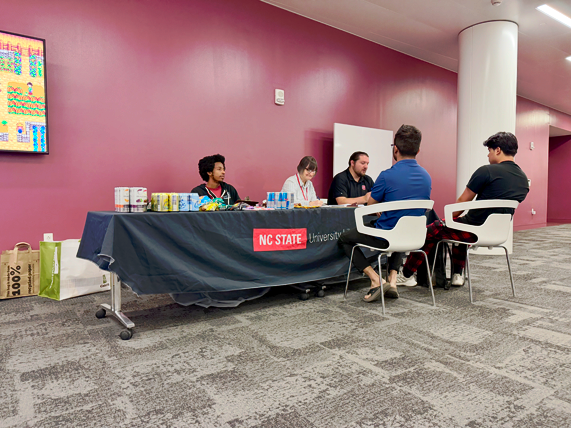
We conducted two Tiny Cafés (pop-up user research) in April and October 2025. For both Tiny Cafés, we set up tables and signs just outside the GEL on the fourth floor of Hunt Library. We used the same script and notetaking instrument for both Tiny Cafés.
The first Tiny Café took place on Thursday, April 17, 2025 from 1–3pm. We offered Panera coffee and treats, along with 3D-printed trinkets, and we conducted interviews with 19 participants, all students.
The second Tiny Café took place on Wednesday, October 22, 2025 from 6–8pm. We offered energy drinks and snacks, along with 3D-printed trinkets, and we conducted interviews with 21 participants, all students.
Research questions
- Do patrons like being there?
- Is the space meeting their needs?
- How did current users find out about the space?
- How are people using the space (recreation/relaxing, competitive, coursework/research)?
- Have we created a video gaming community where all are welcomed and respected?
- Do esports users feel out of place in the library? Or are we attracting more users because it's in the library?
- What do students NOT care about?
- Do people like the lighting and furniture in the space?
- Do people bring their own equipment to use in the space?


